The Death of God as the Self-Overcoming of Christianity. What, in all strictness has really conquered the Christian God? The answer may be found in my Gay Science (section 357): "Christian morality itself, the concept of truthfulness taken more and more strictly, the confessional subtlety of the Christian conscience translated and sublimated into the scientific conscience, into intellectual cleanliness at any price. To view nature as if it were a proof of the good and providence of a God; to interpret history to the glory of a divine reason, as the perpetual witness to a moral world order and moral intentions; to interpret one’s own experiences, as pious men long interpreted them, as if everything were preordained, everything a sign, everything sent for the salvation of the soul — that now belongs to the past, that has the conscience against it, that seems to every more sensitive conscience indecent, dishonest, mendacious, feminism, weakness, cowardice: it is this rigor if anything that makes us good Europeans and the heirs of Europe’s longest and bravest self-overcoming.
All great things bring about their own destruction through an act of self-overcoming: thus the law of life will have it, the law of the necessity of "self-overcoming" in the nature of life — the law-giver himself eventually receives the call. . . In this way Christianity as a dogma was destroyed by its own morality; in the same way Christianity as morality must now perish too: we stand on the threshold of this event. After Christian truthfulness has drawn one inference after another, it must end by drawing its most striking inference, its inference against itself.
MSU.org SELECTED NIETZSCHE TEXTS
...then why have this conversation?
30 January 2006


29 January 2006
is that all...
George: You take the trouble to construct a civilization...to build a society based on the principles of...you make government and art, and realize that they are, must be, both the same...you bring things to the saddest of all points...to the point where there is something to lose...then all at once, through all the music, through all the sensible sounds of men building, attempting, comes the Dies Irae. And what is it? What does the trumpet sound? Up yours.
Albee, Edward; "Who's afraid of Virginia Woolf"; 1966
...there is, my friend?
Albee, Edward; "Who's afraid of Virginia Woolf"; 1966
...there is, my friend?
27 January 2006
nothing exists...
What has been exists no more; and exists just as little as that which has never been. But everything that exists has been in the next moment. Hence something belonging to the present, however unimportant it may be, is superior to something important belonging to the past; this is because the former is a reality and related to the latter as something is to nothing.
A man to his astonishment all at once becomes conscious of existing after having been in a state of non-existence for many thousands of years, when, presently again, he returns to a state of non-existence for an equally long time. This cannot possibly be true, says the heart; and even the crude mind, after giving the matter its consideration, must have some sort of presentiment of the ideality of time. This ideality of time, together with that of space, is the key to every true system of metaphysics, because it finds room for quite another order of things than is to be found in nature.
Schopenhauer, Arthur, "The Emptiness of Existence," Essays of Schopenhauer, eBooks@Adelaide
...then exists and after that doesn't exist again?
26 January 2006
breaking wind...
The Question Arises ...
What makes it serious
is that we know
that after the order
of this world
there is another.
What is it like?
We do not know.
The number and order of possible suppositions in
this realm
is precisely
infinity!
And what is infinity?
That is precisely what we do not know!
It is a word
that we use
to indicate
the opening
of our consciousness
toward possibility
beyond measure,
tireless and beyond measure.
And precisely what is consciousness?
That is precisely what we do not know.
It is nothingness.
A nothingness
that we use
to indicate
when we do not know something
from what side
we do not know it
and so
we say
consciousness,
from the side of consciousness,
but there are a hundred thousand other sides.
Well?
It seems that consciousness
in us is
linked
to sexual desire
and to hunger;
but it could
just as well
not be linked
to them.
One says,
one can say,
there are those who say
that consciousness
is an appetite,
the appetite for living;
and immediately
alongside the appetite for living,
it is the appetite for food
that comes immediately to mind;
as if there were not people who eat
without any sort of appetite;
and who are hungry.
For this too
exists
to be hungry
without appetite;
well?
Well
the space of possibility
was given to me one day
like a loud fart
that I will make;
but neither of space,
nor possibility,
did I know precisely what it was,
and I did not feel the need to think about it,
they were words
invented to define things
that existed
or did not exist
in the face of
the pressing urgency
of a need:
the need to abolish the idea,
the idea and its myth,
and to enthrone in its place
the thundering manifestation
of this explosive necessity:
to dilate the body of my internal night,
the internal nothingness
of my self
which is night,
nothingness,
thoughtlessness,
but which is explosive affirmation
that there is
something
to make room for:
my body....
Artaud, Antonin; "To Have Done with the Judgement of God," a radio play, broadcast on French radio February 2, 1948
...is that all there is?
24 January 2006
and the mirror kept reflecting...
In the philosophical sense, the major implication of epiphenomenalism is that what we do or feel is never caused by what we experience or have experienced. This implication goes much further than the negation of free will. As subjective beings, we are completely impotent confronted by the processes of the material world. We cannot exert any influence upon them, but we are completely determined by them. Our relations with reality, our relation with ourselves, with other persons, with objects, etc., are completely caused by physiological processes in the brain.
Such relations never initiate anything. Thus, epiphenomenalism anthropologically implies an "imprisoned" consciousness that can undertake absolutely nothing and never has any power over itself. Naturally, this metaphysics has great consequences for the axiology and ethics. In fact, axiologically epiphenomenalism implies that all our values are biogenical; there are no values that would not be epiphenomena of neurological processes.
Rivas, Titus & van Dongen, Hein Exit Epiphenomenalism: The Demolition of a Refuge published in the Journal of Non-Locality and Remote Mental Interactions, vol. 57, 2001
Epiphenomenalism is the view in philosophy of mind according to which physical events have mental effects, but mental events have no effects of any kind. This is a radical idea because it denies the concept that the mind has any control over the body, or even any ability to cause an action in the world. Human experience is present, but inert.
Wikipedia: Epiphenomenalism
... even what it could not see?
20 January 2006
on holiday...

...sunset off the coast of Cuba
Philosophers mean to be on holiday as they turn to Nietzsche -- that may be why so many non-specialists feel perfectly competent to talk or even write books about Nietzsche. On holiday, one seeks the liberating prospect of the open sea, the roar of the waves, or a sense of mountain air and clear light.
Babich, Babette E., HEIDEGGER'S RELATION TO NIETZSCHE'S THINKING: ON CONNIVANCE, NIHILISM, AND VALUE
clarity, competence, calmness, connivance, chaos...?
12 January 2006
mirror, mirror on the wall...
A mirror neuron is a neuron which fires both when performing an action and when observing the same action performed by another (possibly conspecific) creature. Thus, the neuron "mirrors" the behavior of another animal, as though the observer were performing the action. These neurons have been observed in primates, some birds, and humans in Broca's and the inferior parietal cortex of the brain. Some scientists consider mirror neurons one of the most important findings of neuroscience in the last decade.
Cells That Read Minds New York Times, January 11, 2006
.... who has the most free will of all?
Cells That Read Minds New York Times, January 11, 2006
.... who has the most free will of all?
11 January 2006
reductive consciousness...
A higher order theory of consciousness is, in a certain sense, a reductive theory of consciousness. Suppose some day we are granted an understanding of sentience and sensory states with their qualitative character. These provide one variety of transitive state consciousness. Suppose we also come to understand mental representation, or at least how thoughts represent. We would then understand two kinds of transitive state consciousness, or two ways of being conscious of something: by sensing it, or by thinking about it. What other resources do we need to give a full account of conscious mental states? It may seem that the latter question is a further and much harder question, requiring new and mysterious resources for its solution. But the bold answer of the higher order theorist is: nothing more is needed. Solving those problems would solve the problem of consciousness. With an understanding of sensory qualities and of how thought represents, you can give a full account not only of mental states but of the difference between conscious mental states and unconscious ones.
Clark , Austen; Phenomenal Consciousness so-called; Presented at the Italian Institute for Philosophical Studies, International School of Biophysics study program "From Neuronal Coding to Consciousness", Ischia (Naples), 12-17 October 1998
...simplified or over-simplified?
Clark , Austen; Phenomenal Consciousness so-called; Presented at the Italian Institute for Philosophical Studies, International School of Biophysics study program "From Neuronal Coding to Consciousness", Ischia (Naples), 12-17 October 1998
...simplified or over-simplified?
07 January 2006
in·stan·ti·ate ii...
[Regarding] those matters which I think I see utterly clearly with my mind's eye … when I turn to the things themselves which I think I perceive very clearly, I am so convinced by them that I spontaneously declare: let whoever can do so deceive me, he will never bring it about that I am nothing, so long as I continue to think I am something; or make it true at some future time that I have never existed, since it is now true that I exist; or bring it about that two and three added together are more or less than five, or anything of this kind in which I see a manifest contradiction.
Descartes, Rene; Meditation 3, AT, 7:36
... 2 + 3 = or ≠ 5?
Descartes, Rene; Meditation 3, AT, 7:36
... 2 + 3 = or ≠ 5?
06 January 2006
cogito, ergo sum...
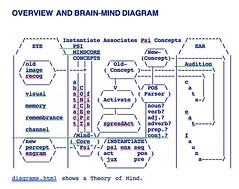
in·stan·ti·ate (ĭn-stăn'shē-āt')
tr.v., -at·ed, -at·ing, -ates.
To represent (an abstract concept) by a concrete or tangible example:
eg. “Two apples … both instantiate the single universal redness”
answers.com
...JUST a theory?
...what would Descartes think?
05 January 2006
thinking...
VLADIMIR:
This is awful!
ESTRAGON:
Sing something.
VLADIMIR:
No no! (He reflects.) We could start all over again perhaps.
ESTRAGON:
That should be easy.
VLADIMIR:
It's the start that's difficult.
ESTRAGON:
You can start from anything.
VLADIMIR:
Yes, but you have to decide.
ESTRAGON:
True.
(Silence.)
VLADIMIR:
Help me!
ESTRAGON:
I'm trying.
(Silence.)
VLADIMIR:
When you seek you hear.
ESTRAGON:
You do.
VLADIMIR:
That prevents you from finding.
ESTRAGON:
It does.
VLADIMIR:
That prevents you from thinking.
ESTRAGON:
You think all the same.
VLADIMIR:
No no, it's impossible.
ESTRAGON:
That's the idea, let's contradict each another.
VLADIMIR:
Impossible.
ESTRAGON:
You think so?
VLADIMIR:
We're in no danger of ever thinking any more.
ESTRAGON:
Then what are we complaining about?
VLADIMIR:
Thinking is not the worst.
ESTRAGON:
Perhaps not. But at least there's that.
VLADIMIR:
That what?
ESTRAGON:
That's the idea, let's ask each other questions.
VLADIMIR:
What do you mean, at least there's that?
ESTRAGON:
That much less misery.
VLADIMIR:
True.
ESTRAGON:
Well? If we gave thanks for our mercies?
VLADIMIR:
What is terrible is to have thought.
Beckett, Samuel; Waiting for Godot, Act II
...is misery?
04 January 2006
allusionary...
There is an order where the subject finds himself in the presence of something entirely beyond his grasp. I would add that if the word “transcendent” has any meaning it is here — it designates the absolute, unbridgeable chasm yawning between the subject and being, insofar as being evades every attempt to pin it down.
Marcel, Gabriel, 1973, p. 193, Tragic Wisdom and Beyond, Translated by Stephen Jolin and Peter McCormick. Publication of the Northwestern University Studies in Phenomenology and Existential Philosophy, ed. John Wild. Evanston, IL: Northwestern University Press
...without mentioning it explicitly?
Marcel, Gabriel, 1973, p. 193, Tragic Wisdom and Beyond, Translated by Stephen Jolin and Peter McCormick. Publication of the Northwestern University Studies in Phenomenology and Existential Philosophy, ed. John Wild. Evanston, IL: Northwestern University Press
...without mentioning it explicitly?
30 December 2005
"real" reality...
The philosophical postmodernists, a rebel crew milling beneath the black flag of anarchy, challenge the very foundations of science and traditional philosophy. Reality, they propose, is a state constructed by the mind, not perceived by it. In the most extravagant version of the constructivism, there is not "real" reality, no objective truths external to mental activity, only prevailing versions disseminated by ruling social groups. Nor can ethics be firmly grounded, given that each society creates its own codes for the benefit of the same oppressive forces.
Wilson, Edward O., Consilience: The Unity of Knowledge, Vintage Books, 1998, p. 44.
...is in the mind of the beholder? ...originator?
Wilson, Edward O., Consilience: The Unity of Knowledge, Vintage Books, 1998, p. 44.
...is in the mind of the beholder? ...originator?
29 December 2005
knowledge, language, learning...
I have been describing the problem of acquisition of knowledge of language in terms that are more familiar in an epistemological than a psychological context, but I think that this is quite appropriate. Formally speaking, acquisition of “common-sense knowledge” – knowledge of a language, for example – is not unlike theory construction of the most abstract sort. Speculating about the future development of the subject, it seems to me not unlikely, for the reasons I have mentioned, that learning theory will progress by establishing the innately determined set of possible hypotheses, determining the conditions of interaction that lead the mind to put forth hypotheses from this set, and fixing the conditions under which such a hypothesis is confirmed – and, perhaps, under which much of the data is rejected as irrelevant for one reason or another.
Chomsky, Noam, Language and Mind: Linguistic Contributions to the Study of Mind , Source: Language and Mind publ. Harcourt Brace Jovanovich, Inc., 1968. One of the six lectures
...language first? ...mind first? ...questions a priori?
Chomsky, Noam, Language and Mind: Linguistic Contributions to the Study of Mind , Source: Language and Mind publ. Harcourt Brace Jovanovich, Inc., 1968. One of the six lectures
...language first? ...mind first? ...questions a priori?
28 December 2005
signs...
Semiotics is the science of communication and sign systems, in short, of the ways people understand phenomena and organize them mentally, and of the ways in which they devise means for transmitting that understanding and for sharing it with others. Although natural and artificial languages are therefore central to semiotics, its field covers all non-verbal signalling and extends to domains whose communicative dimension is perceived only unconsciously or subliminally. Knowledge, meaning, intention and action are thus fundamental concepts in the semiotic investigation of phenomena.
"Semiotics & Communications Theory," Course of study description, Victoria College, British Columbia, Victoria College - Semiotics
...out there or in here with language?
"Semiotics & Communications Theory," Course of study description, Victoria College, British Columbia, Victoria College - Semiotics
...out there or in here with language?
26 December 2005
is there in truth...
What then is truth? A mobile army of metaphors, metonyms, and anthropomorphisms -- in short, a sum of human relations, which have been enhanced, transposed, and embellished poetically and rhetorically, and which after long use seem firm, canonical, and obligatory to a people: truths are illusions about which one has forgotten that is what they are; metaphors which are worn out and without sensuous power; coins which have lost their pictures and now matter only as metal, no longer as coins.
We still do not know where the urge for truth comes from; for as yet we have heard only of the obligation imposed by society that it should exist: to be truthful means using the customary metaphors - in moral terms, the obligation to lie according to fixed convention, to lie herd-like in a style obligatory for all...
'On truth and lie in an extra-moral sense,' The Viking Portable Nietzsche, p.46-7, Walter Kaufmann transl.
...no beauty?
25 December 2005
to be or not to be...
Nothing in the universe can stand by itself - no thing, no fact, no being, no event - and for his reason it is absurd to single anything out as the ideal to be grasped. For what is singled out exists only in relation to its own opposite, since what is is defined by what is not, pleasure is defined by pain, life is defined by death, and motion is defined by stillness. Obviously, the mind can form no idea of what "to be" means without the contrast of "not to be," since the ideas of being and non-being are abstractions from such simple experiences as that there is a penny in the right hand and no penny in the left hand.
Watts, Alan, The Way of Zen, "Mayahana Buddhism," 1957, p. 63
...it is not a question?
Watts, Alan, The Way of Zen, "Mayahana Buddhism," 1957, p. 63
...it is not a question?
24 December 2005
an indication of something...
A sign stands for something to the idea which it produces or modifies....That for which it stands is called its object, that which it conveys, its meaning; and the idea which it gives rise, its interpretant.... [the sign creates in the mind] an equivalent sign, or perhaps a more developed sign. That sign which it creates I call the interpretant of the first sign. This sign stands for something, its object. It stands for that object, not in all respects, but in reference to a sort of idea which I have sometimes called the ground of that representation."
C. S. Peirce, quoted in Umberto Eco (1979) The Role of the Reader 7.2
or something else...?
C. S. Peirce, quoted in Umberto Eco (1979) The Role of the Reader 7.2
or something else...?
12 December 2005
11 December 2005
into the chaos...
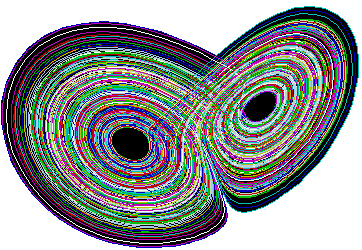
The Universe has a fundamental pattern of fourfoldness throughout all scales of magnitude. When applied to Nature, including Man, the Law of Four manifests as the four attractors. These attractors balance entropy, providing order from out of chaos. When applied in the microcosmic level "the four" manifests as the four basic energies or forces: electro-magnetic, gravity, and the strong and weak forces. In human consciousness its the four functions of sensing, thinking, feeling and willing. Understanding how the Attractors work in the meso-cosmic world can help us make sense of our world, and make sense of our consciousness functions....
The four attractors act on all levels of reality to form Cosmos out of Chaos. They make up a newly discovered Wisdom Law fundamental to making sense of what is happening in the real world. The world is not really totally ordered as previously believed. It is fundamentally disordered, chaotic, but it contains forces or attractors of cosmos that create patterns of order over time. They are anchors of order in an otherwise stormy sea. Full understanding of the Attractors requires a new understanding of space and time....
There is no apparent order at all to the actions of the Strange attractor. On the surface it appears to be pure Chaos, but nevertheless there is order of a subtle kind which only appears over time when looked at in the right perspective. Its analogy in consciousness is the willing function. Yet, when tied to Awareness - the Zero - it is spontaneous, unpredictable. It appears to be chaotic, yet it has order of a subtle, fractal kind.
The Four Chaos Attractors
...it appears over time?
Subscribe to:
Posts (Atom)